
Vineland Elite Roofing provides chimney flashing repair in Vineland, NJ, serving surrounding cities including Buena, Millville, Buena Vista, Rosenhayn and Pittsgrove. Over more than 20 years of roofing, the joint between a chimney and the roof has been one of the most common sources of leaks we trace. The chimney is often the largest single opening in the roof, and the masonry and the roof move differently, so the seal between them has to be built correctly to last.
Every chimney leak call includes a look in the attic as well as on the roof. Water stains around the chimney framing, damp wood and rusted nails show which side of the chimney is failing and whether the water is coming through the flashing, the masonry or the chimney cap. Nothing is priced until we know which.
We replace failed flashing rather than caulking over it. A bead of caulk or a layer of roof cement may stop a leak for a season, but it cracks with heat and cold and hides the condition of the metal underneath. A proper repair puts new flashing into the roof in the right order.
How Chimney Flashing Works
Step Flashing Along the Sides
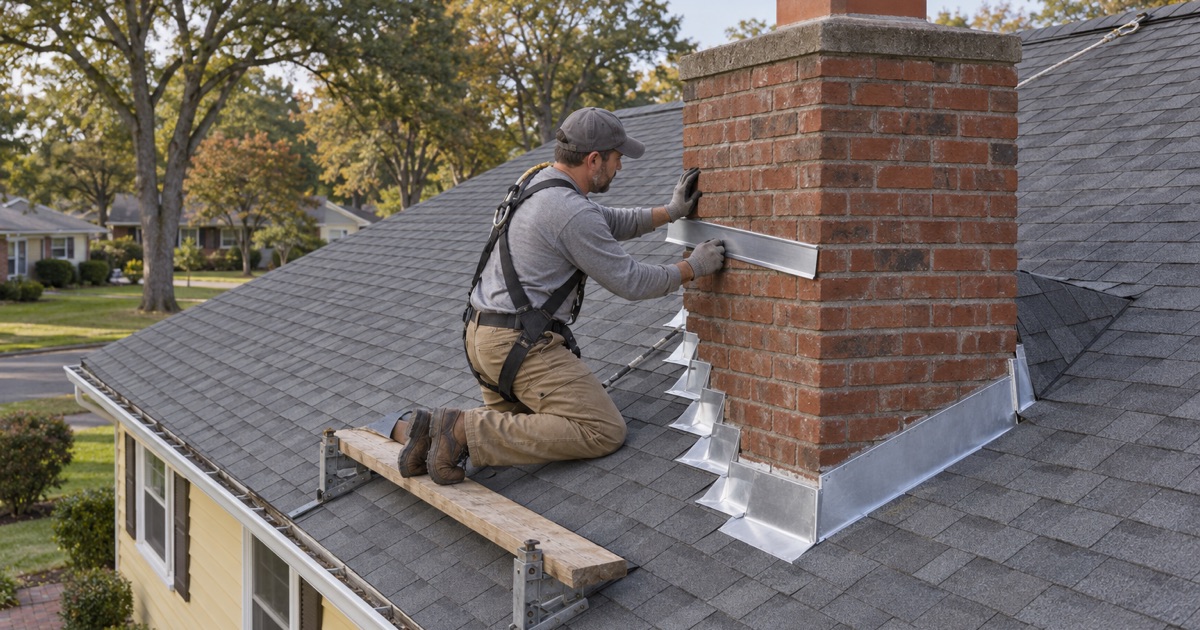
Step flashing is a series of bent metal pieces, one woven into each course of shingles along the sides of the chimney. Each piece laps over the one below, so water running down the side is carried onto the shingles rather than behind them. The pieces are nailed to the roof deck, not to the chimney, so the roof and chimney can move independently.
When step flashing has been reused through a re-roof, cut short or bent out of shape, water can get behind it. We remove the old pieces and install new step flashing with each shingle course, which means lifting and replacing the shingles along each side of the chimney.
Counter Flashing Into the Masonry
Counter flashing covers the top edge of the step flashing and is set into the chimney itself, either into a cut reglet or into a mortar joint. It sheds water running down the face of the brick over the step flashing below. Without it, water simply runs down the masonry and behind the step flashing.
Counter flashing often fails when the mortar holding it has cracked, when it was only glued or caulked to the face of the brick, or when the chimney was repointed and the flashing never reset. We cut a proper reglet or rake out the mortar joint, set new counter flashing and seal it in place.
Apron and Back Flashing
At the front of the chimney, on the downslope side, an apron flashing laps over the shingles below and up the face of the chimney. At the back, on the upslope side, back flashing turns up the masonry and runs under the shingles above. Both are covered by counter flashing.
The back of the chimney catches all the water and debris running down the roof above it, so it is often where leaks start. On a wide chimney, that is also where a cricket belongs, which we cover below.
Crickets and Wide Chimneys
What a Cricket Does
A cricket, sometimes called a saddle, is a small peaked roof built behind the chimney on the upslope side. Instead of water and leaves piling up against the back of the masonry, the cricket splits them to either side and carries them around the chimney. It takes a constant source of standing water away from the most vulnerable joint.
Crickets are framed from wood, covered with ice and water barrier and flashed into the roof and chimney like any other roof surface. They can be added to an existing roof during a flashing repair or built in during a full replacement.
When to Add One
Narrow chimneys on a steep roof often shed water well without a cricket. Wide chimneys, chimneys on lower-pitch roofs and chimneys below a long run of roof above them are the ones that benefit most. Signs that a cricket is needed include debris piling up behind the chimney and repeated leaks at the back flashing.
We explain whether your chimney would benefit and price the cricket as a separate line, so you can decide. Where a cricket makes clear sense, we recommend it rather than repairing the back flashing alone and waiting for it to fail again.
Repairs, Replacements and Masonry
Flashing Repair on an Existing Roof
When the rest of the roof is in good shape, chimney flashing can be replaced on its own. We lift the shingles around the chimney, remove the old flashing and caulk, lay ice and water barrier around the base, and install new step, apron, back and counter flashing. Then the shingles go back, with replacements matched as closely as the existing roof allows.
The written price lists the flashing, any cricket, the shingles being replaced and any decking repair at a per-sheet price shown to you before it is replaced. Damage around a chimney that has leaked for a long time sometimes extends into the decking.
Flashing With a New Roof
When a roof is replaced, every piece of chimney flashing is replaced too. Reusing old step flashing and bending it to fit new shingles is a common shortcut, and it is one of the main reasons a new roof leaks at the chimney within a few years. New flashing costs little compared with the damage a leak causes.
We also look at whether a cricket should be added during the replacement, since it is easiest to build while the roof is open. The flashing appears as its own line in the roof scope so you can see what is included.
Masonry Problems Near the Roof
Sometimes the leak at a chimney is not the flashing at all. Cracked mortar joints, a broken chimney crown or a missing chimney cap can let water into the masonry itself, where it runs down inside and shows up near the roof line. Flashing replaced over leaking masonry will not stop that water.
We repoint the joints where counter flashing is set. For larger masonry repairs, such as rebuilding a crown or the top of the stack, we tell you what we see and recommend a mason or chimney specialist. Knowing the real source keeps you from paying for flashing work that cannot solve the problem.
- 20+ Years in Roofing
- Attic-First Leak Checks
- Line-Item Written Scopes