
Vineland Elite Roofing handles flat roof repair in Vineland, NJ, serving surrounding cities including Buena, Millville, Buena Vista, Rosenhayn and Pittsgrove. In more than 20 years of roofing, a good share of the leaks we have traced have come from the low-slope parts of houses: the porch roof, the rear addition, the attached garage and the dormer with almost no pitch. Those roofs need different materials and different repairs from the shingled roof above them.
A flat roof does not shed water quickly the way a pitched one does, so it relies on a continuous membrane with sound seams, edges and flashings. When one of those fails, water can travel sideways under the surface before showing up inside, often some distance from the damage. Finding the real entry point is the first part of every flat roof repair.
We identify the type of roof you have, trace the leak from inside and out, and give you a straight answer on whether a repair will hold. The written price names the materials being used, which must be compatible with the existing membrane for the repair to last.
Types of Flat Roofs We Repair
EPDM Rubber Roofs
EPDM rubber is a black membrane installed in sheets, with seams joined by adhesive or tape. On houses it is common on porch roofs, additions and garages. Its usual failure points are seams that have opened, membrane pulling away from walls, and punctures from foot traffic or fallen branches.
Repairs use EPDM-compatible primers, seam tapes and patches, applied to a cleaned surface so they bond properly. Where the membrane has shrunk and pulled away from a wall, we rework the wall flashing so it is secured and covered by counter flashing rather than relying on adhesive alone.
TPO and PVC Membranes
TPO and PVC are single-ply membranes, usually white, with seams welded together with hot air. They are less common on houses than EPDM but appear on newer additions and some larger low-slope roofs. A welded seam is strong, but a seam that was poorly welded at installation can open over time.
Repairs require the same type of membrane welded in place, because TPO and PVC do not bond reliably to other materials. We identify which one is on the roof before quoting, since a patch of the wrong material will not hold.
Modified Bitumen and Rolled Roofing
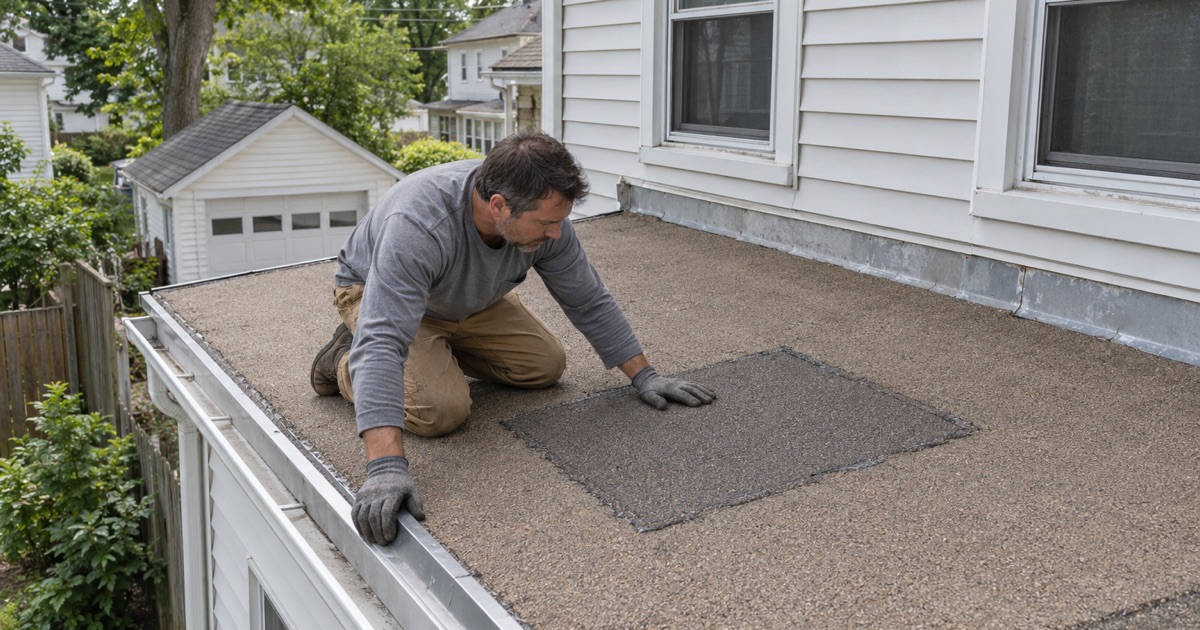
Modified bitumen, whether torch-down SBS or APP, is installed in overlapping layers with a granulated or coated surface. It is common on porch roofs, rowhouse roofs and small commercial buildings. Older houses may also have mineral-surfaced rolled roofing on low-slope sections, which is thinner and wears out faster.
Common problems are open laps, blisters, cracks in the surface and worn areas where water has stood. We repair with compatible materials and careful attention to the laps, using safe torch practices around walls and wood trim. Where rolled roofing has reached the end of its life, we explain the replacement options.
Where Flat Roofs Leak
Seams and Laps
Every flat roof has joints between sheets or rolls, and those are where most leaks begin. An EPDM seam can lose adhesion, a TPO weld can separate, and a modified bitumen lap can open as the surface ages. Even a small gap lets water under the membrane.
We check every seam in the area of the leak, probing for gaps rather than relying on what the surface looks like. Repairs are made over clean, prepared surfaces, and we reinforce nearby seams that show early signs of trouble so the next leak is not a few feet away.
Walls, Edges and Penetrations
Where a flat porch roof meets the house wall, the membrane has to turn up the wall and be covered by flashing. Old caulk, membrane that has pulled away and missing counter flashing are common causes of leaks at this joint. Edges with loose drip edge or gravel stop let wind and water under the perimeter.
Pipes, vents and skylights through a flat roof need flashings made for that membrane. We replace failed flashings rather than adding more sealant, because sealant on a joint that moves with temperature changes cracks and opens within a season or two.
Drains, Scuppers and Ponding
Flat roofs drain through gutters at the edge, scuppers through a parapet or internal drains. When those are blocked or poorly sealed, water backs up and stands on the roof. Standing water adds weight and wears the membrane faster where it sits.
We clear and reseal drainage points and check for low spots where water collects. If a sag in the deck is causing ponding, we explain that the real fix involves the structure, not just the membrane, and price it that way.
Repair or Replace a Flat Roof
When a Repair Makes Sense
A repair is the right choice when the membrane is still flexible and well attached, the damage is in one area and the deck underneath is dry and solid. On those roofs, a properly made repair can give years of further service. We quote the repair and nothing more.
The written price lists the area being repaired, the materials and any flashing work. You also get photos of the damage and the finished repair, which help if the area needs attention again later.
When Replacement Is Better
If the membrane is brittle, cracked across large areas or blistered throughout, or if the deck or insulation underneath is wet, repairs will only buy short periods between leaks. Many older porch roofs reach this point after several rounds of patches. Replacing them puts down a continuous new membrane over a sound deck.
We show you the evidence and explain the options, such as EPDM, TPO or modified bitumen, or standing seam metal where the slope allows. Our contracts follow New Jersey’s home improvement rules, including the written contract and the three-day cancellation notice.
Flat Roofs and the Main Roof Together
A porch or addition roof often fails where it meets the main house, and the main roof may also be getting older. If both need work, doing them together lets the joint between them be flashed correctly in one visit. We can quote the flat section and the main roof separately so you can decide how to proceed.
If only the flat section needs work, we disturb as little of the main roof as possible and match any shingles we lift. Either way, the site is cleaned at the end of each day, with a magnet sweep for nails.
- 20+ Years in Roofing
- Attic-First Leak Checks
- Line-Item Written Scopes