
Vineland Elite Roofing provides roof leak repair in Vineland, NJ, serving surrounding cities including Buena, Millville, Buena Vista, Rosenhayn and Pittsgrove. More than 20 years of chasing leaks have taught us that the spot where water drips into a room is rarely the spot where it gets into the roof. Finding the real entry point is most of the job, and getting it right is the difference between a repair and a return visit.
That is why every leak call starts in the attic as well as on the roof. From inside, we follow the water along rafters, sheathing and insulation back to where it first appears, then go up and find the joint, nail hole, seam or boot that let it in. Only then do we write a price, because a price written before the source is found is a guess.
You will also get a plain answer on whether the leak can be repaired or whether the roof is past repairing. Most leaks are local problems on otherwise sound roofs, and they deserve a local fix. When that is the case, the repair is all we quote.
How We Trace a Roof Leak
Starting From the Stain
We start where you see the water, whether that is a ceiling stain, a drip from a light fixture or damp wall paint. We note the room, how the stain is shaped and spread, and when it appears, such as during heavy rain, wind from one direction or melting snow. That timing alone often points to the kind of joint that is failing.
From there we work out where that spot sits under the roof, allowing for how far water can run along a rafter or the top of the drywall before it drips. A stain near an exterior wall often traces to the eave or the gutter line, while one near the middle of the house may lead back to a vent pipe, a chimney or a valley.
Following the Water in the Attic
In the attic we look for the trail: dark streaks on the rafters, water stains on the underside of the decking, rusted nail tips, wet or matted insulation and daylight where none should be. We follow the trail uphill from where it ends to where it begins, which is where the water is getting through the roof.
The attic also tells us when a leak is not a roof leak. Frost or drips on nail tips in cold weather point to condensation from poor ventilation, and wet areas around a bathroom fan duct can mean the fan is venting into the attic. Plumbing lines and air conditioning condensate lines can also leak above a ceiling. We check all of these before blaming the roof.
Confirming the Source on the Roof
With the likely entry point located from inside, we go onto the roof and examine that area closely. We look at the shingles, the flashing, the boots and the nails, and lift tabs where needed to check what is underneath. On a flat roof, we check seams, laps and penetrations working outward from the area above the leak.
We photograph what we find, both from the attic and from the roof, so you can see the cause for yourself. Those photos go with the written repair price, and they also serve as a record if you later need to show an insurer, a buyer or another contractor what was wrong and what was fixed.
The Most Common Roof Leak Sources
Pipe Boots and Roof Vents
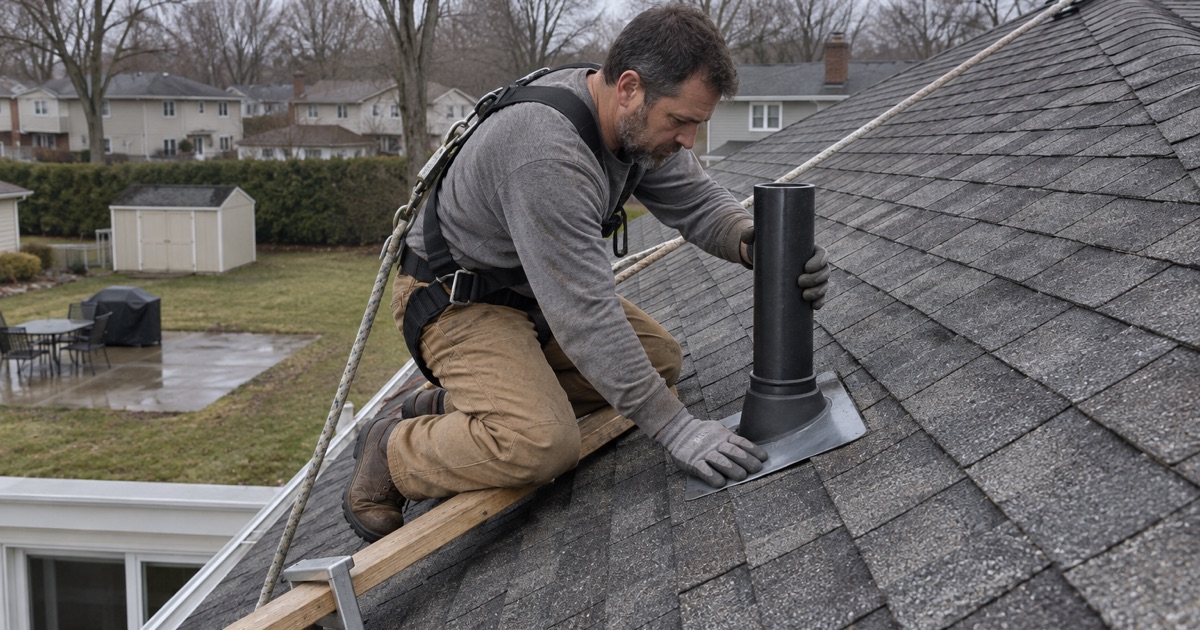
Rubber pipe boots around plumbing vents crack as they age in the sun, letting water run down the pipe and into the attic. Roof vents and exhaust caps fail the same way when their seals dry out or their fasteners back out. These leaks are common, easy to miss from the ground and usually show up as stains in bathrooms, hallways and kitchens.
We replace cracked boots with new ones lapped correctly into the shingle courses, and reseat or replace failing vents. Fasteners are sealed or replaced, and old holes from removed equipment are properly closed rather than dabbed with sealant. It is a modest repair that stops a large share of the leaks we find.
Chimney and Wall Flashing
Where a roof meets a chimney or a sidewall, step flashing woven into each shingle course and counter flashing above it keep water out. Over time counter flashing works loose from the mortar, step flashing gets cut short or bent during a re-roof, and caulk applied in place of proper flashing cracks. A missing kick-out flashing at the bottom of a wall run can send water into the wall itself.
We replace failed flashing rather than caulking over it. That means lifting the shingles around the joint, installing new step flashing, setting counter flashing into a cut reglet or mortar joint, and adding kick-out flashing where it is missing. On wide chimneys without one, we explain how a cricket would help shed water around the masonry.
Valleys and Roof-to-Roof Joints
Valleys carry water from two slopes at once, and the joints where an addition or porch roof meets the main house carry similar loads. A valley with worn shingles, nails driven too close to the center or no ice and water barrier underneath is a common leak source, especially in heavy rain or during melting snow.
We open the valley or joint and rebuild it from the deck up, with ASTM D1970 self-adhering ice and water barrier underneath and shingles or valley metal installed in the correct order. Patching the surface of a valley rarely works for long, because that is where the most water on the roof runs.
Leaks at the Edges and Below the Roof
Eaves, Drip Edge and Gutters
Water that appears at the top of an exterior wall or on the soffit often comes from the roof edge. A missing or short drip edge lets water wrap under the shingles and run down behind the gutter, soaking the fascia and sometimes the top of the wall. Gutters that are clogged or pitched the wrong way can overflow back toward the house.
We check that the drip edge is present and laps into the gutter, that the gutter is clear and pitched to its leader, and that the fascia behind it is sound. Rotted fascia is replaced before a gutter is rehung. These leaks are often blamed on the gutter alone when the roof edge is the real cause.
Ice Dams in Winter
In winter, snow melting over a warm attic can refreeze at the colder eave and build a ridge of ice that holds water on the roof. That water backs up under the shingles and leaks in along the outer walls, often only during a thaw. The underlying causes are heat escaping into the attic and too little ventilation to keep the roof deck cold.
We deal with the immediate leak and then look at the insulation and ventilation that caused it. During a replacement or larger repair, we run ice and water barrier up from the eave. Fixing the shingles without addressing the attic means the same ice will form again next winter.
Skylights
Skylights leak at their flashing more often than through the unit itself. Curb-mounted skylights rely on flashing around a raised frame, and deck-mounted units rely on their own flashing kit, and both can fail when shingles around them are replaced carelessly or the flashing ages. Condensation on the glass can also run down and look like a leak.
We check the flashing, the seals and the unit, and tell you which one is the problem. A sound skylight is reflashed; one with a failed glass seal or cracked frame is better replaced. Either way, the fix goes back into the roof in the correct order so the next rain stays outside.
After the Leak Is Fixed
Temporary Repairs and Tarping
When a leak cannot be permanently repaired right away, because of weather or because a larger repair needs materials ordered, we can make a temporary repair or tarp the area to stop more water getting in. Tarps are fastened to the framing rather than to loose shingles so they stay put in wind.
We photograph what was covered and follow up with a written price for the permanent repair once the roof is dry. A tarp or temporary patch is not a repair, and we make sure it does not stay on longer than it has to.
Storm Damage Records and Claims
If the leak followed a storm, we photograph and write up the damage for your own insurance claim, and our crew will meet the adjuster on site when you ask. We describe storm damage as storm damage and wear as wear, which keeps the report credible.
In New Jersey, negotiating a claim on your behalf is the job of a licensed public adjuster under N.J.S.A. 17:22B, not a roofer. We document and explain what we found; the settlement itself is between you and your insurer.
- 20+ Years in Roofing
- Attic-First Leak Checks
- Line-Item Written Scopes